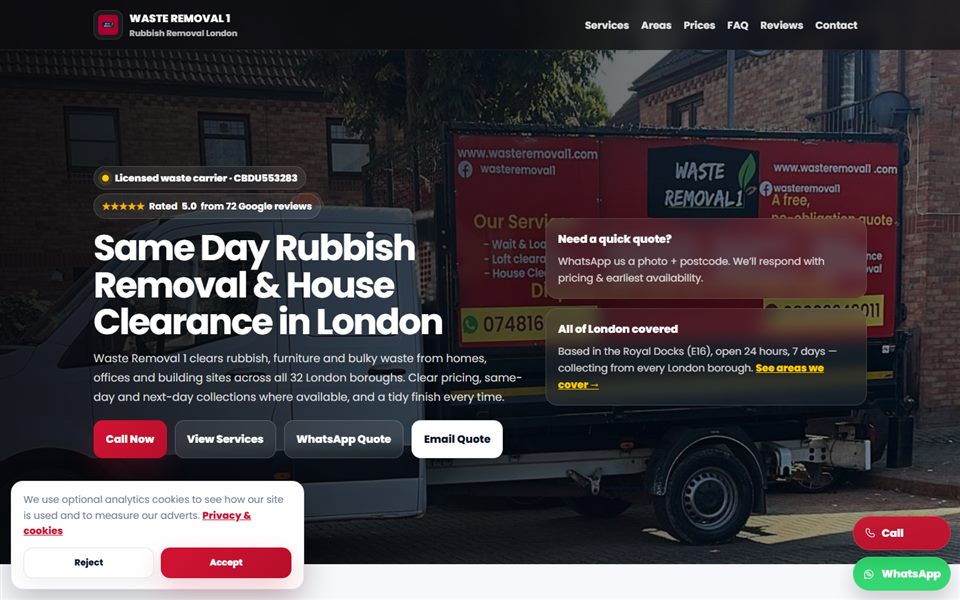
Local service business
Waste Removal 1
Rubbish and house clearance company covering all of London, with service pages, area pages, a price guide and quotes by phone or WhatsApp.
Visit wasteremoval1.comHome / Ecommerce website design London
Online shops for London retailers and brands, built on WooCommerce or Shopify. We design stores that load quickly, are easy to buy from on a phone and are structured so your products can be found on Google. Ecommerce websites start from £1,596.
Selling online is simple to start and hard to do well. Shoppers compare you with the biggest retailers in the country, and they leave if a page is slow, a photo is poor or the checkout asks for too much.
We design ecommerce websites around the path a shopper takes: find the product, trust the shop, pay without friction. Every decision, from the category menu to the wording on the basket button, is made to remove a reason to leave.
We also know marketplaces. We have built brand websites for three businesses that sell on Amazon, so if you sell on Amazon or eBay as well as your own shop, we understand how the two should work together.
The price of an online shop depends mainly on the number of products and the features you need. These are our starting prices.
| Option | How you pay | Price |
|---|---|---|
| Ecommerce website | One-off project price | from |
| Pay monthly online shop | Fixed monthly payment, no large upfront cost | from |
| Website care plan | Optional: updates, backups and small changes | |
| SEO for online shops | Optional: monthly search optimisation | from |
Launch offer: 20% off standard prices of £500 or more and 10% off standard prices under £500. Standard prices are shown crossed out. Offer ends 30 April 2027. Prices exclude VAT. Payment providers and Shopify charge their own fees, which we explain in your quote. Full price list
Ecommerce website design is the planning and building of a website that sells products or services online. As well as the look of the site, it covers how products are organised, how the basket and checkout work, how payment is taken, how delivery is charged and how orders reach you.
A good ecommerce design does three jobs. It helps shoppers find the right product quickly. It gives them enough information and reassurance to buy. And it makes paying so easy that nobody gives up halfway.
These are the two platforms we recommend to small and medium-sized shops, and we build on both.
WooCommerce is a free ecommerce plugin for WordPress. You own the website outright and choose your own hosting. It is very flexible, has no monthly platform fee and suits shops that also want strong content, such as guides and blog posts. It does need hosting, updates and security to be looked after, which is what a care plan is for.
Shopify is a hosted platform. You pay Shopify a monthly fee and it takes care of hosting, security and updates. It is quick to launch, reliable under heavy traffic and easy for a non-technical owner to run. It is less flexible than WooCommerce, and extra features often come as paid apps.
If you want the lowest running cost and full control, or content is a big part of your marketing, choose WooCommerce. If you want the least technical upkeep and are happy with a monthly platform fee, choose Shopify. Tell us about your products and we will recommend one and explain why.
Every extra second of loading time costs sales. We compress product images, limit plugins and apps, and test the shop on a mobile connection.
Good photos, a price that is easy to see, delivery cost and time stated up front, and a description that answers the questions a shopper would ask in a real shop.
Guest checkout, as few fields as possible, and the payment methods your customers already use, including Apple Pay and Google Pay where the platform supports them.
Real contact details, a clear returns policy, secure payment badges and genuine customer reviews. We never add invented reviews.
Every shop is different, but these are the features our clients ask for most. All of them are available on both WooCommerce and Shopify, either built in or through a trusted plugin or app.
You do not need all of these on the first day. We recommend launching with what your customers need to buy comfortably, then adding features when the sales data shows they are worth it.
Opening the shop is the start. The businesses that do well online keep improving three things.
New shops rarely rank on the first day. SEO builds your unpaid visitors over time, while Google Shopping and social adverts can bring buyers straight away. We can run both.
If a hundred people visit and one buys, doubling that to two is worth as much as doubling your traffic, and usually costs less. Better photos, clearer delivery information and a shorter checkout all help.
It is easier to sell again to someone who has already bought. Order follow-up emails, a newsletter and the occasional offer bring customers back without paying for the click a second time.
A shop holds customer details and takes payments, so it must be kept updated and backed up. On Shopify the platform does much of this. On WooCommerce our care plan, at £45 a month, covers updates, backups and security checks.
Free quote
You tell us what you sell, how many products you have and how you deliver. We recommend a platform and send a fixed price.
Plan
We agree the categories, the product information we need and the payment and delivery rules.
Design
We design the home page, a category page and a product page. You approve them before we build.
Build and test
We load products, connect payments and delivery, and place test orders from start to finish.
Launch
We go live, submit the shop to Google and show you how to manage products and orders.
Three of these sites present consumer products and send shoppers to buy on Amazon. The product pages, comparison pages and guides are the same building blocks we use in an online shop.
Rubbish and house clearance company covering all of London, with service pages, area pages, a price guide and quotes by phone or WhatsApp.
Visit wasteremoval1.com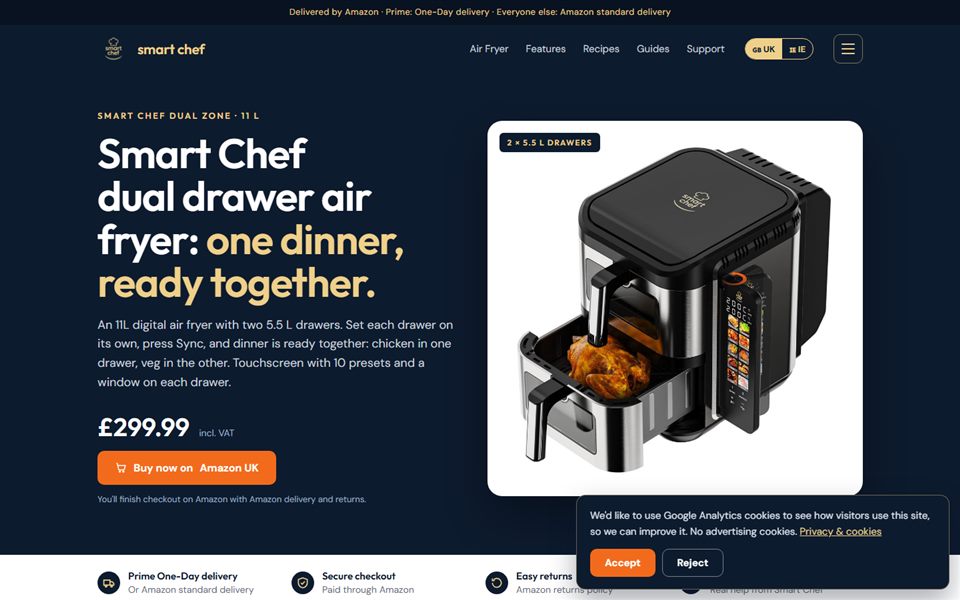
Kitchen appliance brand site with product pages, recipes and guides, and buy links to Amazon UK and Ireland.
Visit smartchef.uk
Smart mini projector brand with a comparison page, buying guides, support pages and UK and Ireland Amazon links.
Visit visyon.uk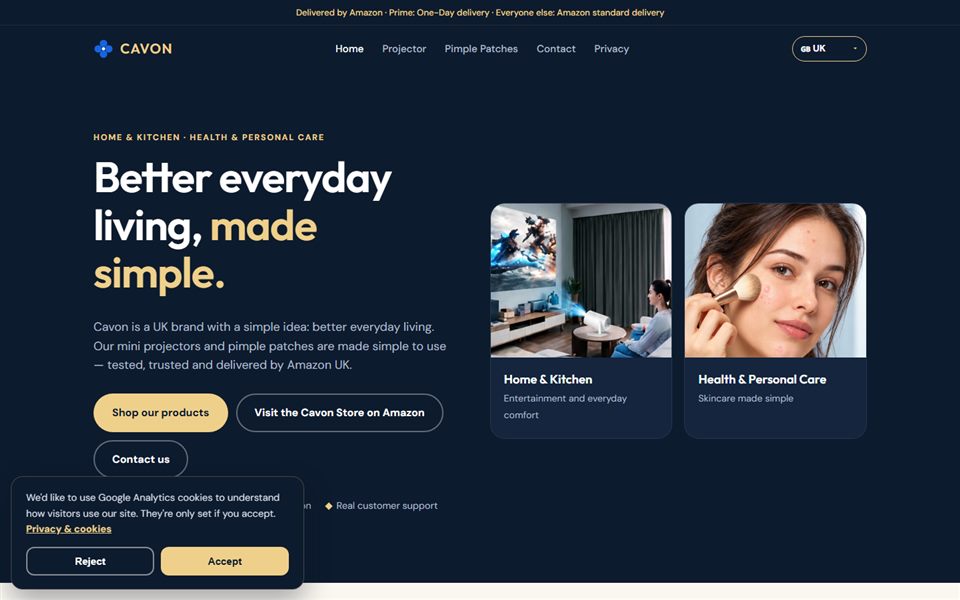
Consumer brand site with product pages and setup guides for products sold on Amazon.co.uk.
Visit cavonofficial.comMost online shops get their first visitors from Google, and more shoppers now ask AI assistants what to buy. Both need to understand exactly what each product is, what it costs and whether it is in stock.
We build that information into the structure of the shop, so each product and category page can rank for the words shoppers use.
An online shop is a real shop in the eyes of the law and of your customers, so a few things need to be in place before you take the first order. We build these pages and settings into every ecommerce project and tell you where you need to supply the details.
Clear business details. Customers must be able to see who they are buying from: your business name, a contact address and a way to get in touch.
Delivery information. What it costs, how long it takes and where you deliver, shown before the checkout, not after.
Returns and cancellations. Online shoppers in the UK have cancellation rights, and your returns policy should explain how they work in plain words.
Prices that include VAT where you sell to the public, with the total shown before payment.
Privacy and cookies. A privacy policy that says what you do with customer details, and consent for any analytics or advertising cookies.
Secure payment. Card details are handled by the payment provider, not stored on your website.
We are web designers, not solicitors, so for anything unusual about your products we will suggest you take advice. For a typical shop, though, getting these basics right is straightforward, and customers notice when a shop has done it properly.
If you already trade on Amazon or eBay, you will have most of this information to hand, and we can reuse your product details and photos to get your own shop open quickly.
Our ecommerce websites start from £1,596 as a one-off project, or from £62.99 a month on a pay monthly plan. The final price depends on the number of products and the features you need, and is fixed in your written quote.
WooCommerce gives you full control and no platform fee but needs hosting and maintenance. Shopify is easier to run and includes hosting, for a monthly fee. We recommend one after hearing about your products and how you work.
Through a payment provider such as Stripe, PayPal or Shopify Payments, set up in your own name. Money from sales goes straight to your account. The provider charges a small fee per sale.
Yes. We show you how to add products, change prices, manage stock and process orders.
Yes. We can move products, customers and order history, and redirect old page addresses so you keep your search rankings.
Your own website gives you a brand home that you control, a place to explain your products properly and, if you sell direct, customers who belong to you. Many brands use both: the website builds trust and Amazon handles the order.
Website Designer 1 builds WooCommerce and Shopify stores for London businesses from £1,596. Each shop is designed for phones first, set up with secure payments and delivery rules, and structured so products can be found on Google. You get a fixed price before we start and training when we finish.
Tell us what you need. We reply with a clear price and no obligation.