Clear statements of fact
Who you are, what you do, where you work and what it costs, in plain sentences on your own website.
Home / SEO / Generative engine optimisation London
Generative engine optimisation, or GEO, for London businesses. More customers now ask ChatGPT, Gemini, Copilot, Perplexity and Google's AI Overviews for a recommendation instead of scrolling through search results. We help your business become one of the names those tools mention. Our AI search visibility audit is £179.
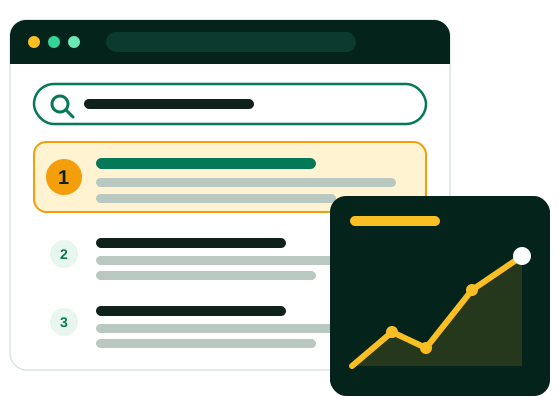
Search is changing. For twenty years a person typed a few words into Google and chose from a list of links. Today many people ask a full question and receive a written answer: "Which web designers in East London publish their prices?" or "Who can service a boiler in Ilford this week?" The answer names two or three businesses. The rest are not mentioned at all.
Those answers are produced by generative AI, which is software that writes a response by drawing on what it has learned and what it can find on the web. Generative engine optimisation is the work of making sure your business is known, understood and trusted by those systems, so that it is included.
We are an SEO and web design team in East Ham, East London. GEO is a new field, and we approach it honestly: there are things that clearly help, and there is a great deal nobody can guarantee.

Start with the one-off audit to see where you stand. Ongoing GEO work is carried out within our monthly SEO plans, because the two rely on the same foundations.
| Service | What it covers | Price |
|---|---|---|
| AI search visibility audit | One-off check of how AI assistants describe your business, with a written action list | |
| SEO Growth | Monthly SEO and GEO work across several services or areas | |
| SEO Advanced | Monthly SEO and GEO work for competitive London-wide keywords | |
| SEO Premium | Monthly SEO and GEO work for ecommerce and national targets |
Launch offer: 20% off standard prices of £500 or more and 10% off standard prices under £500. Standard prices are shown crossed out. Offer ends 30 April 2027. Prices exclude VAT. Audit and SEO plan prices
Generative engine optimisation is the practice of improving how a business appears in answers written by AI. The "generative engines" are tools such as ChatGPT, Google Gemini, Microsoft Copilot, Perplexity and Claude, together with the AI Overviews that Google now shows above its ordinary results for many searches.
You may also see it called AI search optimisation, answer engine optimisation or AI SEO. The names differ; the aim is the same. When someone asks an AI a question that your business could answer, you want the AI to know that you exist, to describe you accurately and, ideally, to recommend you or cite your website as a source.
These tools work in two broad ways, and most now combine them.
First, they have training knowledge. Each model was built by processing an enormous amount of text, and it carries a general memory of what it read. A business that is widely and consistently mentioned across the web is more likely to be part of that memory.
Second, they search. When asked about something current or local, most tools now run a live web search, read the top results and write an answer from them, often with links to their sources. For these answers, the pages that rank well in ordinary search are the raw material. A business that cannot be found by a search engine is unlikely to be found by an AI using one.
That is why GEO does not replace SEO. It builds on it. A website that is technically sound, clearly written and well regarded gives both systems what they need.
We put a set of realistic customer questions to the main AI tools: questions about your trade, your area and your business by name. We record which businesses are mentioned, whether you are among them, what is said about you, whether it is correct and which sources are cited. This is the baseline everything else is measured against.
To an AI, your business is an "entity": a thing with a name, a type, a location and a set of facts. We make those facts clear and identical everywhere they appear. Your website states plainly who you are, what you do, where you are based, which areas you serve, your prices or price ranges, your opening hours and your company details. Your Google Business Profile, directory listings and social profiles are corrected to match.
AI tools favour passages that can be quoted as they stand. We restructure key pages so that each important question is followed by a direct answer in one or two sentences, with supporting detail after it. We add the questions customers really ask, with specific, factual answers: costs, timescales, what is included, who it suits. Vague marketing language gives an AI nothing to use.
Schema markup is a standard way of labelling information for machines. We add or correct schema for your organisation, your local business details, your services, your products, your frequently asked questions and your reviews, and we test it for errors.
AI answers lean on a familiar set of sources: Google Business Profiles, major review sites, established directories, trade bodies, news sites and well-known reference sites. We make sure you are present and accurate on the ones that matter for your trade, encourage genuine customer reviews, and look for opportunities to be mentioned in relevant articles and lists. This overlaps with our link building work.
AI companies use their own crawlers to read the web. Some websites block them without knowing, through a security setting or a line in the robots.txt file. We check your settings, make sure important content is in readable text and not hidden inside images or scripts, and confirm that pages load quickly. A full review of this kind is part of a technical SEO audit.
We repeat the same test questions at intervals and compare the answers with the baseline. Where your business appears more often or is described more accurately, we know what worked. Where it does not, we adjust.
The audit is a one-off piece of work for £179 and is the best place to start. You receive a written report covering:
You can carry out the actions yourself, or ask us to do them as part of a monthly plan.
This is a young and fast-moving field, and you should be wary of anyone who claims certainty. Nobody outside the AI companies knows exactly how their systems choose what to say, the systems change often, and the same question can produce different answers on different days.
So we do not guarantee that a particular tool will recommend your business. What we can do is carry out the steps that are well supported by evidence and by the AI companies' own guidance: make your business clear, consistent, factual, well reviewed and easy for machines to read. Those steps also improve your ordinary search rankings and your website's usefulness to customers, so the work is not wasted whichever way search develops.
Any business whose customers ask for recommendations can benefit, but some feel the change sooner. Local services are a clear case, because "who is good for this near me" is a natural question to put to an assistant. Professional firms are another, since people ask AI tools to explain a problem and then ask who can help. Online shops and product brands are affected because shoppers now ask for comparisons and "best for" suggestions. And any business whose details are wrong or out of date online has a particular reason to act, because AI tools repeat mistakes with confidence.
Generative engine optimisation is not a separate campaign to run alongside everything else. It is a set of standards applied to work you should be doing anyway. Clear service pages come from SEO content writing. Accurate local details come from local SEO. Sound foundations come from an SEO audit. GEO adds a specific question to each of those: could an AI read this, understand it and repeat it correctly?
We build our own websites to these standards: plain statements of fact, published prices, structured data on every page and consistent business details. We explain what we are doing in everyday language. We show you the actual answers the AI tools gave, before and after. And we are straightforward about uncertainty, so you can decide how much to invest in a channel that is still taking shape.

Five steps, beginning with what the AI tools say about you today.
Free quote
Tell us your business, services and area. We confirm the audit price or recommend a plan.
Baseline test
We ask the main AI tools a set of customer questions and record every answer.
Audit report
You receive the findings, the errors, the competitors named and a prioritised action list.
Improve
We fix your details, content, structured data and listings, in order of impact.
Re-test
We repeat the questions and report what has changed.
Clear statements of fact
Who you are, what you do, where you work and what it costs, in plain sentences on your own website.
Consistent business details
The same name, address, phone number and description on every listing and profile.
Genuine reviews
Recent, detailed reviews from real customers on the platforms AI tools read.
Direct answers to questions
FAQ sections and guides that answer in the first sentence and explain afterwards.
Structured data
Schema markup that labels your business, services, prices and questions for machines.
Mentions on trusted sites
Directories, trade bodies, local press and articles that name your business.
For many searches, Google now shows a written summary at the top of the results, produced by AI and accompanied by a few links to the pages it drew on. These AI Overviews appear most often for questions and comparisons. They change the results page in two ways. Some searchers read the summary and go no further, so fewer clicks reach any website. But the pages cited beside the summary gain a prominent position, above the ordinary listings.
Being one of those cited sources is the practical aim. The pages chosen tend to rank well already, answer the question directly, and present facts in a form that is easy to extract: a short definition, a list of steps, a table of prices. That is the format we build into your key pages.
A person who reads a wrong phone number on an old directory might notice that it looks out of date. An AI tool will not. It may repeat the closed branch, the old address or last year's prices as fact, in a confident sentence, to a customer who has no reason to doubt it. It may also blend your details with those of a business that has a similar name.
The remedy is consistency. When your own website, your Google Business Profile and every major listing give the same name, address, phone number, opening hours and description, an AI has no conflict to resolve. Cleaning up those records is often the single most useful GEO task for a small business, and one of the first things our audit checks.
To prepare your content, it helps to know how people phrase requests to an assistant. They tend to describe their situation and ask for a recommendation or an explanation. Typical forms include "who is the best", "which is cheaper", "what should I look for when choosing", "how much should I expect to pay", "is it worth", and "can you recommend someone near" a named place. They add conditions: open on Sundays, fixed prices, speaks a particular language, covers a certain postcode.
Each condition is a fact your website can state. If you publish your prices, say so. If you work evenings and weekends, say so. If you cover particular boroughs, list them. An AI cannot recommend you for a quality it has never seen written down.
Shoppers increasingly ask AI tools to compare products and suggest the best option for a need or a budget. For a brand, being included depends on clear product information: what the item is, its specifications, who it suits, how it differs from alternatives, and what buyers say about it. Complete product schema, detailed descriptions written in full sentences, and genuine reviews on your own site and on marketplaces all feed those answers. For brands that sell on Amazon, a website of your own gives AI tools an authoritative source for facts about your products.



GEO stands for generative engine optimisation. It means improving how your business appears in answers written by AI tools such as ChatGPT, Gemini, Copilot, Perplexity and Google's AI Overviews.
Our AI search visibility audit is a one-off £179. Ongoing GEO work is carried out within our monthly SEO plans, from £134.99 a month.
It builds on SEO. AI tools often search the web and write from the top results, so good SEO is the foundation. GEO adds a focus on clear facts, consistent business details, structured data and mentions on trusted sources.
No. Nobody can. The AI companies do not publish how their systems choose, and answers vary. We carry out the steps known to help and show you the before and after results.
We ask the main AI tools the same set of customer questions before the work and at intervals afterwards, and compare how often and how accurately your business is mentioned.
Answers that rely on live web search can change within weeks of your website and listings being improved. Changes to a model's built-in knowledge take much longer, because models are retrained only periodically.
The usual cause is wrong or conflicting information online. We find the source, correct your website and listings, and re-test. Most tools also provide a way to report inaccurate answers.
Yes. Your website is the main source AI tools use for facts about your business, and it is where a customer goes to check you and get in touch after an AI has mentioned you.
Tell us what you need. We reply with a clear price and no obligation.